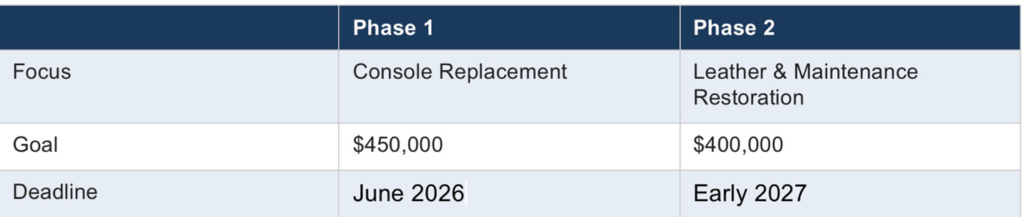
With heartfelt gratitude, we thank everyone who contributed to Sustain the Sound, Phase One. Because of your generosity, we have reached our goal of $450,000. We are deeply grateful for your partnership and enthusiasm. While we celebrate this milestone, we are also excited for what lies ahead. Sustain the Sound, Phase Two will begin next year, and we look forward to continuing this journey together.
 Westminster Presbyterian Church’s Austin Organ (Opus 2734), installed in 1991 by Austin Organs, is the acoustic and spiritual centerpiece of our sanctuary. For more than three decades, this magnificent instrument has anchored traditional worship at our 8:30 and 11:00 a.m. services, accompanied the renowned Chancel Choir, drawn regional audiences to Organ Summer concerts, and provided the soundtrack for countless weddings, funerals, and milestone celebrations in the life of this congregation and the broader South Hills community.
The organ now requires significant renewal in two critical areas. First, the console – the command center where the organist sits, the keyboard interface through which every note is selected, every stop is drawn, and every musical decision is made – must be fully replaced.
The console is the hands and mind of the instrument; without it, the thousands of pipes above are silent. Second, the organ’s internal leathers, and mechanical components require comprehensive service to ensure reliable operation for decades to come.
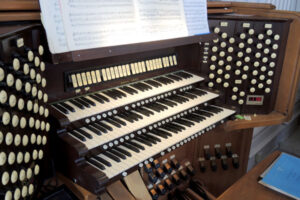 The console is the large desk-like structure where the organist sits. It contains the keyboards (called manuals), the pedalboard played by the feet, and dozens of stops, the knobs or tabs the organist draws to select which sets of pipes will sound. The console also houses the organ’s electronic and mechanical switching systems that translate the organist’s touch into airflow through specific pipes.
Think of it this way: if the pipes are the voice, the console is the brain and the hands. Every musical decision—every note, every color, every dynamic shift—flows through the console. It is the cockpit of the instrument.
Most people see the pipes and think that is the organ. But the music doesn’t start in the pipes. It starts at the console. Without the console, the pipes don’t sound.
Westminster’s Austin organ console has served faithfully since 1991. Until October 26, about ten minutes before the 8:30 worship service was to start. Chris Hestwood, our Director of Music, and Jim Burns, our long-time organist, were standing in the hallway outside their office when they heard a loud sound. They ran into the sanctuary and discovered that the sound came from the organ. There was also a burning smell. Jim pivoted and played the service from the piano.
Later that week, various organ repair specialists were brought in, and each determined that the console was irreparably damaged–its electrical components were no longer manufactured. Much like any household appliance from 1991, the wiring and circuit boards in the old console were simply too old to be serviced and repaired.
Phase 1 addresses the console because it is the most urgent need. Without the console, we no longer are able to have the pipes sound. Phase 2 then turns to the internal maintenance: replacing aging leathers (the flexible membranes and gaskets that seal the wind system), felts, and other mechanical components that ensure the pipes themselves speak cleanly, consistently, and at proper pitch. Together, these two phases constitute a comprehensive renewal that will carry Westminster’s organ well into the second half of this century.